Zhejiang University's 2B VLA Model Hits 98.4% on LIBERO by Learning State Changes
VLA-Delta turns task progress, spatial displacement and contact change into pretraining targets. The 2B model reaches 98.4% on LIBERO and 68.0% on a real dual-arm robot.
4 min read
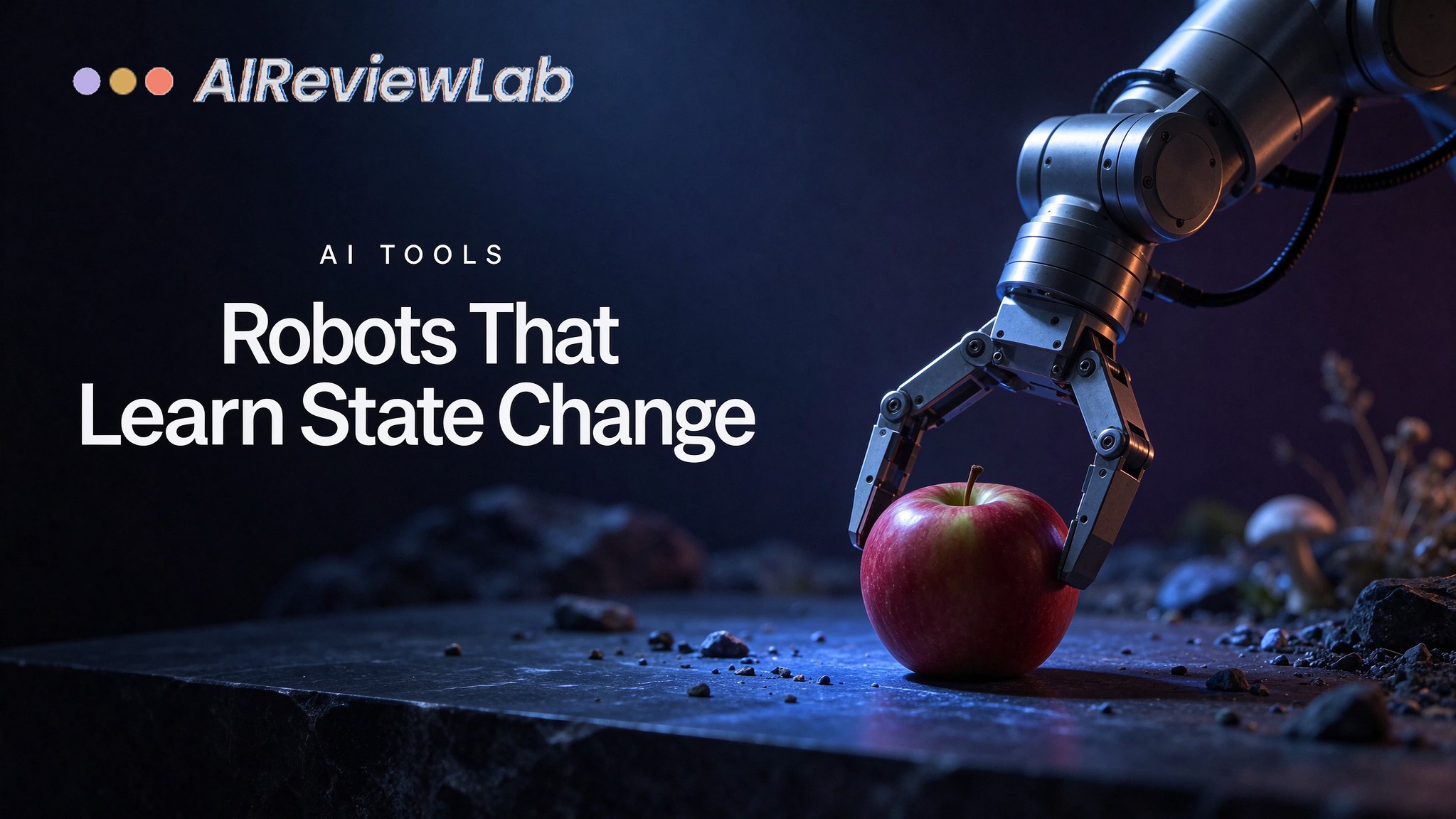
The most common failure in robotic manipulation is not a wrong motion. It is a correct motion that never changes the world. A gripper reaches for an apple, closes, moves toward the bin—and the apple stays on the table. Every step of the procedure was executed. The task still failed.
VLA-Δ, a new model from Zhejiang University's OmniAI team at the ACES Lab, targets exactly the missing signal: what has to physically change between the current state and the goal state. By turning task progress, spatial displacement, and contact change into explicit pretraining objectives, the team trained a 2B-parameter vision-language backbone to 98.4% average success on LIBERO and 68.0% on a real dual-arm robot across five task categories.
Why Visual-Language-Action Models Miss the Goal
Mainstream VLA models predict the next action chunk from camera frames, task instructions, and robot state. Vision-language pretraining supplies rich understanding, and demonstration data links those representations to actions. The problem is that learning "see this, do that" can overfit to the observation-action mapping itself. The policy learns what the scene looks like right before each action, not how the physical state is supposed to evolve.
Consider placing an apple into a container. On approach, the distance between gripper and apple shrinks. On grasp, the relationship changes from separated to in-contact. During transport, the apple leaves the table and moves with the gripper. After release, it acquires a new support surface. Each resulting state changes the preconditions for the next stage.
Prior work injects intermediate information through task plans, chain-of-thought, future images, or latent futures. VLA-Δ aims the learning objective one level deeper—at the task-relevant physical state transitions between now and next: which positions change, which contacts must be established or held, and how those changes advance the task.
Architecture: Physical State Difference Queries
VLA-Δ introduces a set of learnable Physical State Difference Queries. These queries extract a state-change representation from the current image and task instruction. An action expert then combines that representation with robot state to generate continuous action chunks. Functionally, the queries are internal information carriers that the action expert reads from.
Three complementary supervision signals make those carriers informative.
1. Structured Transition Slots
Nine classes of supervision targets organize the most decision-relevant state facts: task progress and stage, target and gripper positions, motion and relative displacement, interactable positions, gripper and contact changes, and obstacle risk. Each slot answers a concrete question: which manipulation stage is this, where is the target, is the gripper about to close or release, and how will the contact relationship change?
The supervision also encourages different query groups to specialize semantically, so the representation divides labor instead of collapsing into one blob.
2. Dense Optical Flow
Approaching an object, adjusting a gripper, and fine alignment all involve small local motion that abstract slots do not capture. VLA-Δ adds dense two-dimensional displacement from optical flow between the current frame and a subsequent frame in the same view. Optical flow alone cannot distinguish task-relevant motion from incidental motion, which is why the structured slots and difference text supply the semantic constraint.
3. Future-State Difference Text
Future-State Difference Text describes the transition in coherent natural language: task progress, spatial change, contact change, and operating constraints. To predict this text, the current image and instruction must first pass through the queries—so the internal representation is pushed to retain semantic content that can explain the task.
All three signals train the same representation set. The action expert then generates continuous action chunks with Flow Matching, conditioned on that representation plus robot state.
Pretraining Data
The team built the pretraining corpus from robot demonstrations in DROID, MolmoAct, and RH20T. The reported scale is roughly 484 hours and 24 million frames, with an automated annotation pipeline generating the structured slots, flow, and difference text for each clip.
Results
Simulation
| Setting | Tasks | Result |
|---|---|---|
| LIBERO | 40 tasks | 98.4% average success, highest among compared methods |
| RoboTwin 2.0 (Clean) | 50 dual-arm tasks | Highest average, +1.36 points over ZR-0 |
| RoboTwin 2.0 (Random) | 50 dual-arm tasks | Highest average, +1.76 points over ZR-0 |
Real Robot
On an AgileX PiPER six-degree-of-freedom dual-arm platform, the team defined five task categories: obstacle avoidance, long-horizon execution, fine manipulation, spatial reasoning, and generalization under background change. Each task was run 40 times, for 200 trials total.
| Model | Average success (5 categories) |
|---|---|
| VLA-Δ | 68.0% |
| ZR-0 | 64.5% |
| π0.5 | 62.5% |
VLA-Δ leads π0.5 by 5.5 points. Within categories, it reaches 42.5% on obstacle avoidance, 72.5% on fine manipulation, and 87.5% on spatial reasoning—the highest of any compared method in each of those three categories.
The real-world numbers matter more than the simulation ones, because they show the pretraining signal transfers to tasks that depend on contact, spatial relations, and operating constraints rather than clean scene layouts.
What the Result Suggests
A grasp or a placement changes position, pose, and contact state. Demonstration trajectories record both the motion and its effect on the environment. VLA-Δ converts the task-relevant part of that effect into explicit supervision: difference text carries task semantics, structured slots describe critical states, and optical flow preserves motion detail, with one unified representation driving continuous control.
The 2B parameter scale is also notable. Much of the recent progress in embodied AI has come from scaling backbones. This result suggests that specifying what the representation should encode can recover a significant share of that gain at a fraction of the size—useful for teams that need to run inference on robot-mounted hardware.
The code and project page are public, and the paper is on arXiv (2610.21306).