
The cost of Seedance 2.0 varies dramatically depending on how you access it. Unlike traditional SaaS tools, it does not follow a simple monthly pricing model. Instead, it operates on a usage-based system driven by compute consumption.
Based on extensive testing and market analysis, a single video can cost anywhere from $0.11 to $2.87, while API usage typically ranges between $0.17 and $0.21 per second.
This guide breaks down:
- Real pricing benchmarks
- Hidden costs most creators overlook
- Case studies with actual numbers
- Proven strategies to reduce cost by up to 80%
If you want a simpler way to manage costs and compare outputs across Seedance 2.0, Kling 3.0, and Sora 2 in one place, platforms like Pollo.ai can streamline the entire workflow without the usual pricing complexity.
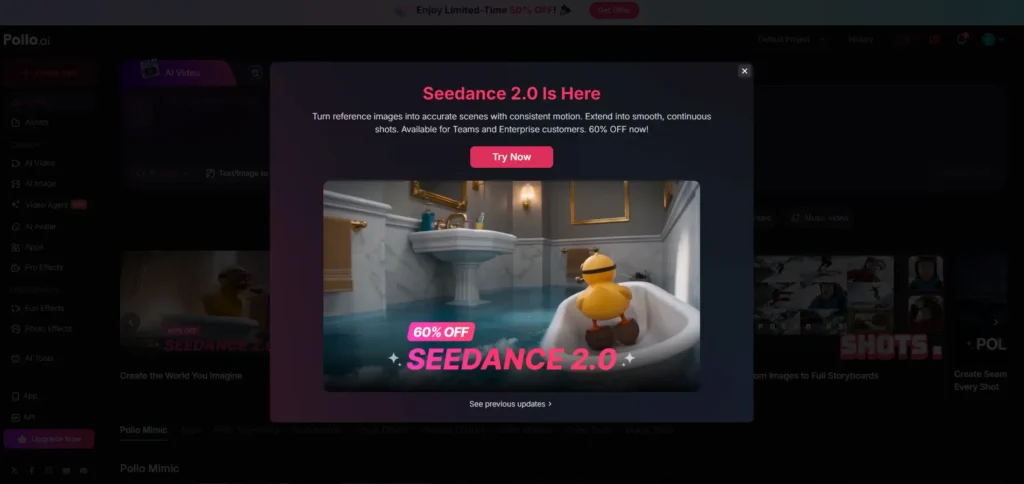
Get Seedance 2.0 — Limited-Time 60% Off!
Understanding Seedance 2.0 Pricing Model (Why It’s Not a Subscription Tool)
Most creators initially assume Seedance works like a typical subscription product. That assumption leads to overspending.
In reality, you are not paying for access — you are paying for GPU compute time.
Key pricing variables:
- Video duration (4s vs 15s)
- Resolution (480p, 720p, 2K)
- Rendering speed (Fast vs Standard)
- Input type (text vs reference video)
This explains why two users generating “the same video” can end up paying 10x different prices.
| Factor | Options | Impact on Cost |
|---|---|---|
| Video Duration | 4s – 15s+ | Longer videos increase cost proportionally |
| Resolution | 480p / 720p / 2K | Higher resolution significantly increases compute cost |
| Rendering Speed | Fast / Standard | Fast mode adds a premium for priority processing |
| Input Type | Text-to-Video / Reference Video | Reference videos increase cost due to input processing |
How Much Does Seedance 2.0 Cost Per Second in Real Usage?
The most accurate way to understand pricing is to break it down per second.
Real benchmark data:
- 480p: ~$0.08–$0.10/sec
- 720p: ~$0.17–$0.21/sec
- 15-second video: ~$1.20–$3.15
Practical takeaway:
A short 4-second clip might cost under $0.30, while longer or higher-quality outputs scale quickly.
👉 In real production environments, cost scales linearly with duration but exponentially with quality requirements.
Seedance 2.0 Cost Benchmarks by Resolution and Duration
| Scenario | Estimated Cost | What It Means |
|---|---|---|
| 480p Video | ~$0.08–$0.10 per second | Most cost-efficient option for bulk or social content |
| 720p Video | ~$0.17–$0.21 per second | Higher quality with moderate cost increase |
| 15-Second Video (Typical Range) | ~$1.20–$3.15 per video | Total cost depends on resolution and settings |
Why Seedance 2.0 Pricing Feels Expensive (And When It Actually Isn’t)
From my testing across multiple workflows, pricing perception depends entirely on how efficiently you generate content.
Scenario comparison:
| Scenario | Cost per Video |
|---|---|
| Optimized (bulk credits) | ~$0.11 |
| API standard usage | ~$1–$3 |
| Inefficient workflow (retries, wrong settings) | $5+ |
Insight:
Seedance is not inherently expensive —
👉 inefficient usage makes it expensive
The Hidden “Aggregator Tax” in AI Video Tools (Why Prices Vary by 10x)
One of the biggest pricing traps is what I call the “Aggregator Tax.”
Through testing multiple platforms, I found:
- Same model
- Same prompt
- Same output
👉 Price difference: up to 10x.
Platforms like Higgsfield can be much more expensive due to added platform fees and markups.
Why this happens:
- Third-party platforms add markup
- Subscription bundling hides real cost
- Lack of transparent per-second pricing
This is the single biggest reason new users overpay.
Official vs Third-Party Access: Where Most Users Overpay
There are three main ways to access Seedance:
1. Official channel (lowest cost)
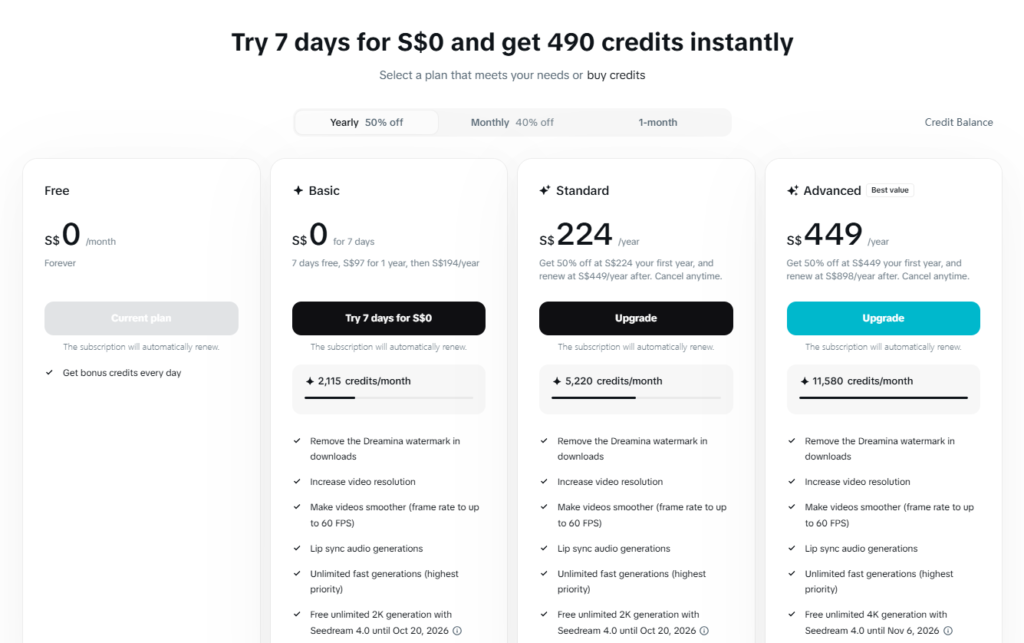
Based on my calculations using the official Dreamina pricing:
- Annual plan: $449/year (intro price, renews at $898/year)
- Equivalent monthly cost: $37.42/month
- Monthly credits: 11,580 credits
- Cost per 4-second video: 88 credits
- Total videos per month: ~131 videos
- Cost per video: ~$0.28
However, if you choose the monthly plan instead:
- $24/month only gives 2,115 credits
- Resulting cost per video jumps to ~$1.00 per video
The annual plan reduces cost per video by over 70%
Monthly plans are significantly less cost-efficient
Pricing varies dramatically depending on subscription strategy
Cost Comparison: Annual vs Monthly Plan of Dreamina
| Plan Type | Price | Credits per Month | Videos per Month (4s) | Cost per Video |
|---|---|---|---|---|
| Annual Plan (Discounted) | $449/year (~$37.42/month) | 11,580 | ~131 videos | ~$0.28 |
| Monthly Plan | $20/month | 2,115 | ~24 videos | ~$0.83 |
2. API access (developer-friendly)
- Predictable per-second cost
- Scalable for production
3. Aggregators (highest cost)
- Convenience
- Significant markup
Key insight:
👉 Choosing the wrong access method can increase your cost by 5–10x instantly
Higgsfield Pricing Breakdown (Ultra Plan)
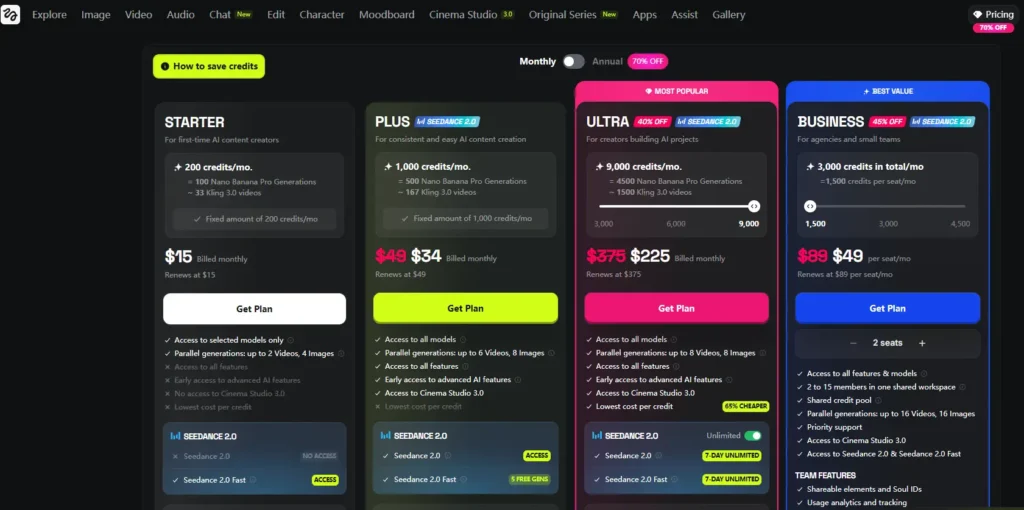
To better understand the pricing, let’s look at a third-party platform—using Higgsfield as example to estimate Seedance 2.0 costs.
Based on current pricing:
- Higgsfield yearly Ultra Plan: $135/month
- Credits: 9,000 credits
- Cost per 4-second video:
- Standard: 24 credits
- Promotional period: 16 credits
Cost calculation:
- During promo:
- ~562 videos (9000 ÷ 16)
- Cost per video ≈ $0.26
- Without promo (standard rate):
- ~375 videos (9000 ÷ 24)
- Cost per video ≈ $0.36
However, if switching to a lower-tier monthly Ultra plan (or less efficient usage),
👉 cost per video can rise to approximately $0.6 per video
Cost Comparison: Dreamina (Official) vs Higgsfield
| Platform | Plan Type | Monthly Cost | Credits | Videos (4s) | Cost per Video |
|---|---|---|---|---|---|
| Dreamina (Official) | Annual (discounted) | ~$37.42 | 11,580 | ~131 | ~$0.28 |
| Dreamina (Official) | Monthly | $24 | 2,115 | ~24 | ~$0.83 |
| Higgsfield | Annual Ultra Subscription | $135 | 9,000 | 375 | ~$0.36 |
| Higgsfield | Monthly Ultra Subscription | $225 | 9,000 | 375 | ~$0.60 |
How Many Videos Can You Generate with $100 on Seedance 2.0?
One of the most practical benchmarks from testing:
- $100 ≈ 222,000 credits
- 1 generation ≈ 255 credits
- Total output ≈ 870 videos
👉 Effective cost: ~$0.11 per video
What this means:
- Ideal for bulk short-form content
- Massive ROI when used correctly
Why $119/Month Subscriptions Often Waste Your Budget
Subscription plans sound attractive but often fail in practice.
Observed issues:
- Unused credits expire
- Usage fluctuates monthly
- Overpaying for unused capacity
Real-world insight:
In most workflows, subscription users end up with a higher effective cost per video than pay-as-you-go users.
How Much Does Seedance 2.0 API Cost? (Per Minute Pricing Explained)

Seedance 2.0 API uses a pay-as-you-go pricing model, making it suitable for both early-stage prototyping and large-scale production environments.
Quick Answer
Seedance 2.0 API pricing typically ranges from $0.10 to $0.80 per minute of generated video, depending on resolution, quality settings, and computational complexity.
Seedance 2.0 API Pricing Breakdown
| Factor | Pricing Impact |
|---|---|
| Base Cost | Starts at ~$0.10 per minute |
| High Quality Output | Can increase up to ~$0.80 per minute |
| Resolution | Higher resolutions (e.g. 1080p) cost more than 720p |
| Compute Complexity | Complex motion and multimodal scenes increase cost |
Where to Access the Seedance 2.0 API
The API is officially available through:
- Volcengine
- BytePlus
These platforms provide enterprise-grade infrastructure for integrating Seedance into applications and workflows.
Free Credits and Trial Access
In practical testing, new enterprise accounts often receive free trial credits, which are typically enough to generate:
- Multiple short HD videos
- Several 15-second clips
This allows developers to:
- Test output quality
- Optimize prompts
- Estimate real production costs before scaling
Key Insight for Developers
The pay-as-you-go model provides precise cost control:
- You only pay for actual usage
- Costs scale with output complexity
- No fixed subscription overhead
👉 This makes Seedance 2.0 API particularly effective for teams that need flexible scaling without committing to high monthly costs
Pay-As-You-Go vs Subscription: Which Actually Saves Money?
Pay-As-You-Go:
✅ Flexible
✅ No waste
✅ Ideal for variable usage
Subscription:
❌ Fixed cost regardless of usage
❌ Often leads to unused credits
Conclusion:
👉 For 90% of creators, pay-as-you-go is more cost-efficient
The Real Cost of Failed Prompts in AI Video Generation
One of the most underestimated costs is iteration.
Typical workflow:
- 3–5 attempts per usable video
Impact:
If each attempt costs $1:
- Final usable video = $3–$5
Insight:
👉 Your real cost is not per generation —
👉 it’s per successful output
Reference Video Costs Explained (Why Your Bill Can Double)
Using video-to-video generation introduces a hidden cost layer.
Example:
- Input video: 10 seconds
- Output video: 10 seconds
👉 You may be billed for both
Result:
- Cost can double unexpectedly
Optimization tip:
- Trim input videos before upload
- Avoid unnecessary processing time
Seedance 2.0 Pricing vs Kling vs Sora (Cost Comparison)
Market positioning:
| Tool | Cost | Strength |
|---|---|---|
| Kling | Cheapest | Budget workflows |
| Seedance | Mid-range | Motion consistency |
| Sora | Premium | Cinematic quality |
Insight:
👉 Seedance sits in the value-performance middle
Best Strategy to Reduce Seedance 2.0 Costs by 80%
Based on testing multiple workflows, these strategies consistently reduce cost:
1. Use official credit systems when possible
2. Avoid Fast mode unless necessary
3. Stick to 480p–720p for social content
4. Trim reference videos
5. Minimize failed prompts through prompt optimization
👉 Combined impact: up to 80% cost reduction
Monthly Cost Breakdown: What Creators Actually Spend
Case 1: Short-form content creator
- 30 videos/month
- 10 seconds each
- Cost: $25–$45/month
Case 2: Commercial production
- 10 high-quality videos
- Multiple iterations
- Cost: $150–$300+ per project
Real Case Study: From $1.48 to $0.11 Per Video
Before:
- Using aggregator platform
- Cost per video: ~$1.48
After:
- Switched to direct credit system
- Cost per video: ~$0.11
Result:
- ~90% cost reduction
- Same output quality
Key takeaway:
👉 Pricing inefficiency, not model capability, is the biggest cost driver
Is Seedance 2.0 Worth It in 2026?
Yes — but only if used correctly.
It is worth it if:
- You optimize workflow
- You avoid aggregators
- You understand cost structure
It is NOT worth it if:
- You rely on subscriptions blindly
- You ignore hidden costs
- You generate inefficiently
FAQ: Real Questions Answered
1. What is the actual price of Seedance 2.0?
It ranges from $0.11 to ~$3 per video, depending on usage.
2. Why is pricing different across platforms?
Because of aggregator markups and pricing models.
3. What is the cheapest way to use Seedance?
Using direct credit-based systems with bulk pricing.
4. How is pricing calculated?
Based on:
- Duration
- Resolution
- Compute time
5. Why does reference video increase cost?
Because input processing is billed, not just output.
6. Is subscription worth it?
In most cases, no — leads to wasted credits.
7. How many videos can $100 generate?
Up to ~870 videos under optimized conditions.
8. Is API cheaper than web platforms?
Often yes, especially at scale.
9. Is Seedance more expensive than competitors?
It’s mid-range — not the cheapest, not the most expensive.
10. Can I reduce costs significantly?
Yes — up to 80% with optimized workflows.
Final Verdict
Seedance 2.0 pricing is not expensive by default — it is highly sensitive to how you use it.
The difference between an inefficient and optimized workflow can be:
👉 $3 per video vs $0.11 per video
Understanding this gap is what separates casual users from high-efficiency creators.
ssing and utilizing smart aggregators like pollo.ai, you can harness the full power of Seedance 2.0 without burning through your production budget.