GPT-6.2 Sol First Benchmarks: 60 Points, 18.7 Minutes, $1.19 a Task
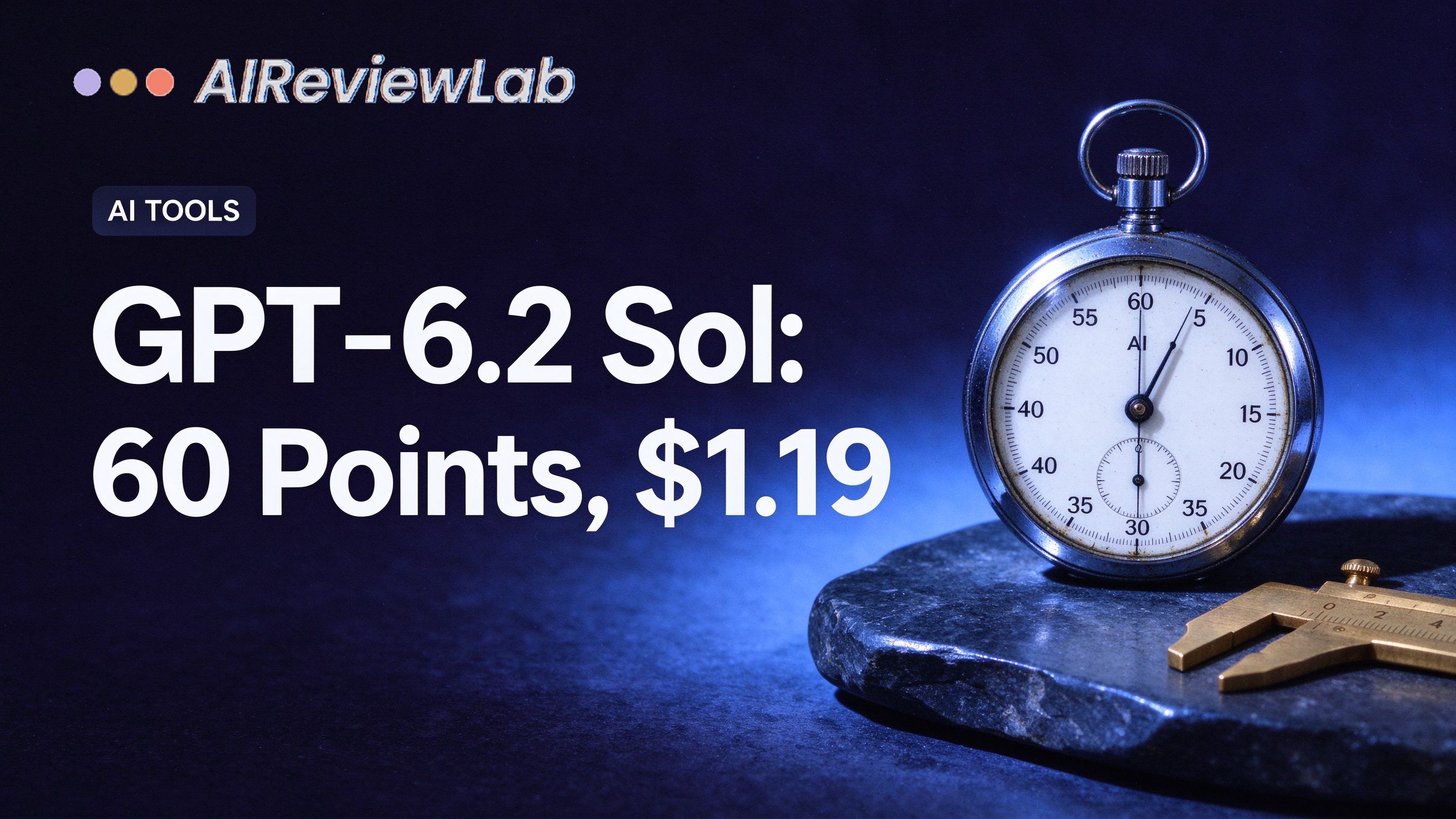
Artificial Analysis puts GPT-6.2 Sol at 60 on intelligence, 18.7 minutes per task, and $1.19 against Opus 5.5's $10.04. The first OpenAI model that clearly outruns Opus 5.5.
4 min read
GPT-6.2 Sol has started rolling out quietly. Users are being routed to it without notice, and the first demos have taken over X. The headline claim from early testers is simple: this is the first OpenAI model that clearly outruns Claude Opus 5.5.
Artificial Analysis has published its first evaluation, and the numbers are not subtle. Sol scores 60 on the intelligence index, matches Gemini 4 Carbon at the top, edges past Opus 5.5, and does it at roughly one-eighth the cost per task.
What Testers Are Seeing
The demos circulating on X are mostly 3D and front-end work. From a single prompt, GPT-6.2 Sol produces a complete interactive 3D scene—full Three.js code packed into one HTML file, no Blender, no external assets, rendering at something close to browser game quality.
Early examples include a black hole render that several testers called the best AI-generated version they had seen, a 3D scene built from Hokusai's The Great Wave with no external assets, a 3D sailboat, a colosseum comparison against Opus 5.5, and a 3D version of the Altman portrait demo.
Token Gremlin, one of the most visible testers, started by saying he had waited a long time for a model that could compete with Opus 5.5, then revised his assessment upward: Sol beats it outright. He also noted that ten or so runs consumed less than 10% of a $200 Pro plan's quota.
The Benchmark Triangle
Artificial Analysis breaks evaluation into three dimensions: intelligence, task duration, and task cost. Sol's profile is unusual because it does well on all three at once.
| Metric | GPT-6.2 Sol | Claude Opus 5.5 | Gemini 4 Carbon |
|---|---|---|---|
| Intelligence index | 60 | slightly below 60 | 60 (tied first) |
| Avg task time | 18.7 min | 25.3 min | 31.1 min |
| Cost per task | $1.19 | $10.04 | not disclosed |
On raw intelligence, Sol's 60 points close a five-point generation gap over GPT-6.1 Sol and surpass the current GPT-6 Astra. Against Opus 5.5, the edge is small but measurable.
Speed
Sol finishes a complex task in 18.7 minutes, against 25.3 for Opus 5.5 and 31.1 for Gemini 4 Carbon. That makes Sol the fastest of the three flagship models on long reasoning chains, up to 40% quicker on dense multi-step tasks.
The caveat worth stating plainly: 18.7 minutes is still slower than the 12.6-minute median for comparable models in the same index. Sol is fast among flagships, not fast in absolute terms.
Cost
The leaked claim was that Sol costs one-third of Opus 5.5 per task. The measured number is better than that: $1.19 versus $10.04, or 11.8% of Opus 5.5—roughly one-eighth. Against GPT-6 Astra, Sol lands at about one-fifth.
Sol's list pricing is $2 per million input tokens and $10 per million output tokens, the same headline rate as several competitors. The cost advantage comes from output discipline: in the intelligence-index run, Sol generated 58.9 million tokens with notably more concise answers than peers, so the effective bill per completed task drops far below the sticker rate.
The model accepts text and image input, returns text, and carries a 1-million-token context window.
How to Tell If You Have It
Users report a reliable check: ask the model, with browsing disabled, whether it knows about Fable 5. If it says yes, you are in the gray rollout. Multiple users also describe a shift in tone—fewer defensive, hedge-heavy responses than earlier ChatGPT versions.
OpenAI's developer account has posted a video titled "Tomorrow," which the community read as a near-term launch signal.
Why It Has Not Launched Yet
Both gpt-6.2-astra and gpt-6.2-sol have been rumored for over a week. Token Gremlin reported that OpenAI found serious safety and alignment problems in the final stage and pulled the release for emergency fixes. That is consistent with the earlier disclosure that the planned 6.1 generation was held back after failing internal safety testing.
Some testers claim an internal timeline pointing to a release next Thursday. Nothing has been confirmed by OpenAI, and the API model IDs leaked earlier this month—rc-ada-or-vm and rc-ada-sh-vm—were pulled within minutes of appearing.
What It Means
For developers, Sol matters less as a benchmark trophy and more as a cost curve. A flagship scoring at parity with the best available models at roughly an eighth of the per-task price changes what long-horizon agent work is economically viable. A workflow that cost $10 a run at Opus pricing drops to about $1.19, which moves whole categories of batch and overnight jobs from marginal to practical.
Two caveats remain. The evaluation is Artificial Analysis's first pass, not a broad independent consensus, and Sol's absolute latency is still above the median for comparable models. The competitive picture will also shift as Anthropic ships its own 5.5 generation. For now, the model is real, the numbers are public, and the release window appears to be days rather than weeks.